
"Free audit" can sound like the front door to a sales pitch. So here is exactly what ours looks at, what we need from you, and what you walk away with. If you decide not to work with us, the audit is still yours.
What we need from you
Your business name or website, and the main city you serve. That is all. The audit page says no account access is needed.
The six checks
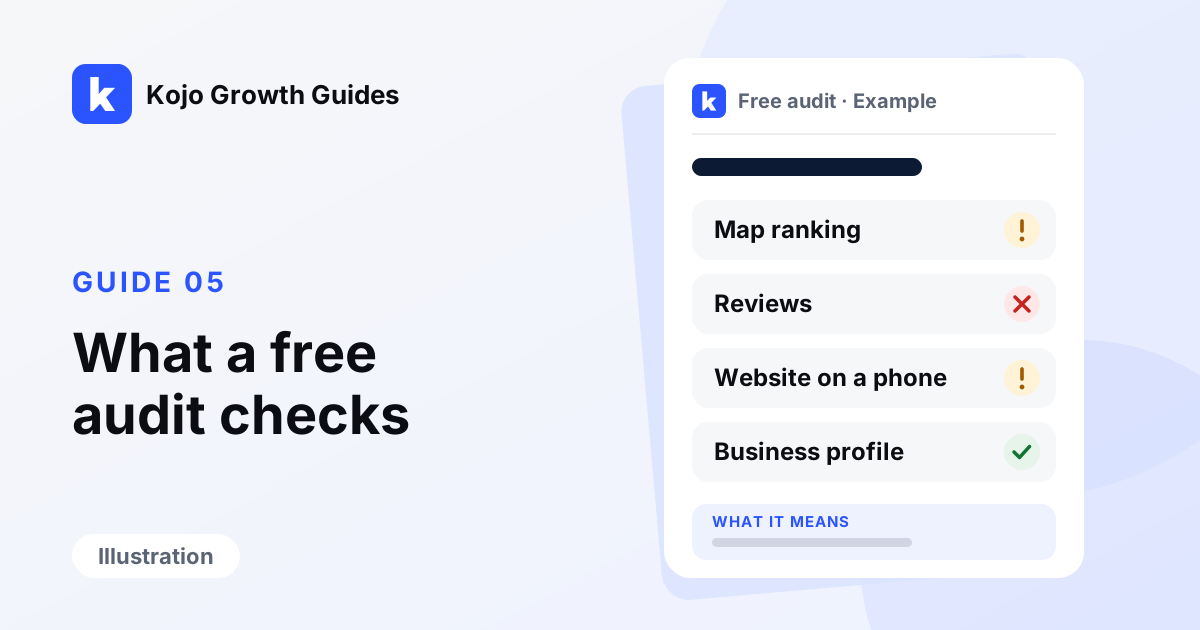
1. Your Google Maps ranking across town. We run a map ranking scan across your service area for your main search, so you see where you show up and where you do not. Distance is one of the three things Google uses for local results, so a business can look different across town than it does near its own shop. That is why one search from your office is not enough.
2. Your reviews against the top three. Review count, rating, how many new reviews came in recently, and how often the owner replies, next to the three businesses that show up above you. Reviews count toward how well known a business is, according to Google. We look at the numbers and the habits behind them.
3. Your website on a phone. How fast it loads, whether each service has its own page, whether the phone number can be tapped to call, whether the form works, and whether AI search can read it. Google says it uses the mobile version of your site for indexing, so the phone view is the one that matters first.
4. Who you're up against. The businesses at the top of the scan, how quickly they collect reviews, and the searches they show up for that you do not. We look at businesses in public search results only, and we do not contact them or their customers.
5. How many people search for what you do. Monthly searches for your services in your towns, from real search data. These are estimates of interest. They are not a count of the customers you will get.
6. The three fixes that matter first. Specific, in order, each tied to something we found. If you hire us they become month one. If you do not, they are yours to keep.
What you get back
A short report in plain English, with the findings and the three fixes. Read each fix and ask which finding it comes from. A fix that is not tied to a finding deserves a question. If you want, we then walk through it with you on a call. Nothing starts until you say yes to a written plan, and the terms are in writing before any work starts. If you want to see how the steps fit together, read how it works.
What an audit is not
- Not a promise of results. An audit describes where you stand today. It cannot say what will happen if you change something, and nobody can say that truthfully. Google's own guidance says no one can guarantee a number one ranking.
- A snapshot, not a forecast. Rankings move. The scan is a picture of one search on one day.
- Not a verdict on your work. A weak map position says nothing about how good you are at your trade. It may only say that Google has less to go on.
- Not a sales trap. The audit is free, no strings. You keep the findings and the three fixes whether or not you work with us.
Questions to ask about any audit
Whoever offers you one, ours included, you are entitled to ask:
- What exactly was checked, and on what date?
- Can I see how you got each finding, so I can check it myself?
- What was not covered?
- Is it mine to keep if I say no?
- Does it promise a result? If it does, be careful.
An audit worth having answers those in plain words.
Do a rough version yourself
You can learn a lot in an hour before you ask anyone. The list under "What to do this week" is a do-it-yourself version of the six checks. Our page on Google Maps and local SEO explains the first two in more depth, and our page on websites covers the third.
What to do this week
- Search your main service on your phone from three places in your area. Write down where you appear in each.
- Look at the three businesses that appear above you. Compare your review count, rating and the date of your newest review with theirs. Do not contact them or their customers.
- Open your website on your phone. Can you find your phone number in ten seconds? Does tapping it start a call? Does your contact form send?
- To get ideas for check 5, list the five searches a customer might type to find you. Real search numbers for them are something the audit adds.
- From all of that, write the three things you would fix first, in order.
- Compare your list with an outside view. That is what the audit is for.
What this does not promise
Doing the checks yourself, or asking for an audit, does not promise a better position on the map, more calls or more revenue. What we find is a description of today, and Google can change how it works at any time.
Ask for yours
Send us your business name or website and the main city you serve. It is free, no strings, and you keep the results either way. Ask for your free audit.