
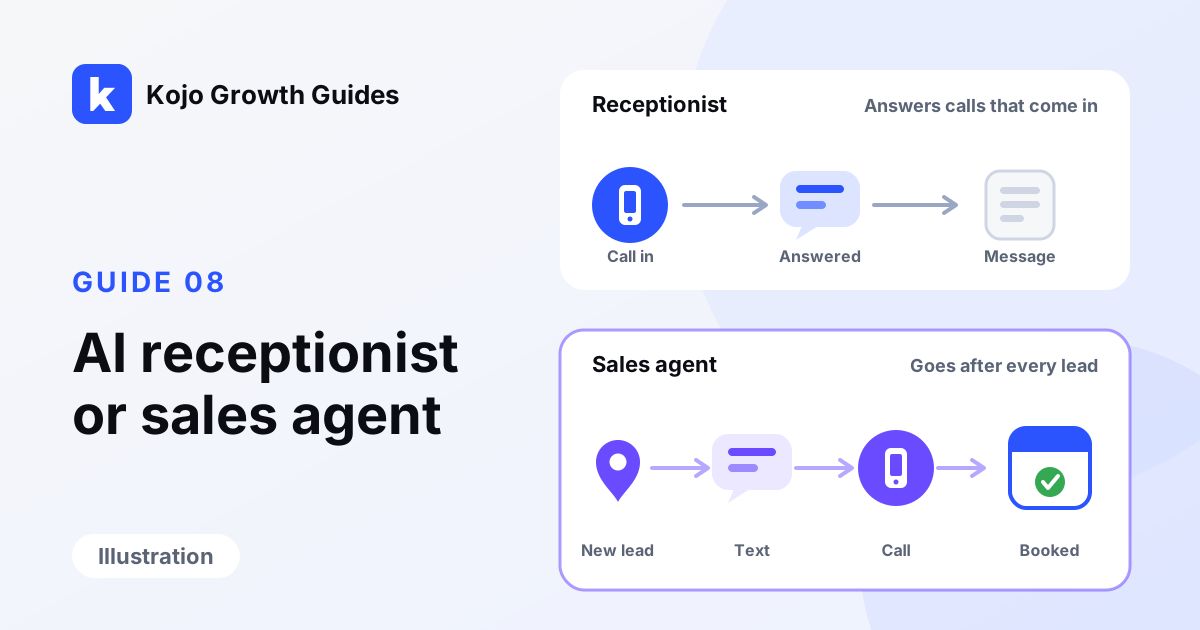
An AI receptionist answers the calls that come in. An AI sales agent goes after leads: it texts and calls new inquiries, follows up until they answer and books the job. If most work starts with a phone call, a receptionist may do. In our view, if leads arrive by form, ad or missed call, a sales agent is the better fit.
This guide compares the two types of tool, not companies, and it says plainly when a receptionist is the better fit. Where we give an opinion, we label it.
What does an AI receptionist do?
An AI receptionist answers your phone when a customer calls. It greets the caller, answers common questions about your hours, services and service area, and takes a message or books a slot on your calendar. Some are sold as an AI answering service or an AI phone agent. It does one job well: the call that rings. By design it responds and does not reach out. Some add callbacks or texts, so check what yours does.
What does an AI sales agent do?
An AI sales agent starts from the lead, not from the ringing phone. A new form fill, ad lead or missed call sets it off. It texts, calls and emails, and keeps following up until the lead answers, books or says stop. Then it puts the appointment on your calendar and logs the work in your CRM. It is meant for people who asked to hear from you.
How are they different side by side?
These are the differences between the two types of tool in general. Individual products vary.
- What starts it. A receptionist starts when a customer calls. A sales agent starts when a lead appears: a form, an ad, a missed call or your own list.
- Main job. A receptionist answers, gives basic information and takes a message or a booking. A sales agent follows up and books.
- Channels. A receptionist lives mostly on the phone line. A sales agent uses texts, email and calls.
- How long it keeps going. A receptionist works for the length of one call. A sales agent keeps going over days, until the lead answers, books or says stop.
- Where the care goes. With a receptionist, it is what the caller is told. With a sales agent, it is who you contact, with what consent and at what hours.
- What you check. For a receptionist, calls answered and messages taken. For a sales agent, leads reached and appointments booked.
When is an AI receptionist the better fit?
In our view, a receptionist is the right first tool for a small business when:
- Almost every job starts with a customer phoning you, and the call itself books it.
- You get few or no leads from forms, ads or a website that need chasing.
- The gap is calls that ring when no one can pick up: evenings, weekends or while the crew is on a roof.
- You want a simple tool and do not want to manage outbound scripts and call lists.
If that sounds like you, you may not need a sales agent. Our guide on after-hours answering service or AI covers the night and weekend case in more detail.
When does a service business need an AI sales agent?
A receptionist cannot follow up on a lead that never rang. A form fill, an ad lead or a missed call sits until someone calls back, and a lead who asked three companies for a quote often goes with whoever answers first. That last point is our opinion, not a measured figure. Our guide on speed to lead goes into why the first minutes matter.
In our view, a sales agent earns its place when you pay for leads, when leads come in while your team is on jobs, or when quotes go quiet and nobody has time to chase them.
What do the rules say about AI voices on calls?
In February 2024 the FCC ruled that calls made with AI-generated human voices use an "artificial voice" under the Telephone Consumer Protection Act (TCPA). Such calls need the called person's prior express consent, unless it is an emergency or an exemption applies. If the call introduces an advertisement or is telemarketing, the rules require prior express written consent. The ruling took effect when it was released.
The same ruling points to the rule that the message must state clearly, at the beginning, who is responsible for the call, and that a marketing call must offer a way to opt out. It applies these duties to AI that starts outbound calls to consumers. Our reading: a receptionist answers calls the customer placed, and a sales agent places calls, so consent wording on your forms matters most for the second type. The ruling's duties are written for outbound calls and do not address inbound ones.
There is also a rule on timing. FCC rules bar a telephone solicitation to a residential subscriber before 8 a.m. or after 9 p.m., local time where the person is. Some tools keep to a narrower window of their own. This is a summary of what the documents say, not legal advice. Check with your own adviser about your own calls.
Can you use an AI receptionist and an AI sales agent together?
Kojo OS is an AI sales system, not an AI receptionist. New leads are texted instantly, called within minutes from a local number registered to your business, followed up by text, email and calls until they answer, booked on your calendar and logged in your CRM. It also answers callers who ring in, but following up and booking is its job. Each business sets its own calling hours. See what is in Kojo OS.
Can you use both? Yes. In our view the sensible pairing is a receptionist for calls that come in and a sales agent for leads that did not ring. The risk is two systems holding two versions of the same customer, so point both at one calendar and one CRM.
What to do this week
- List last month's new leads by how they arrived: phone calls, forms, ads, missed calls and texts. Use your phone log, form inbox and CRM.
- Mark which of them were answered or called back, and roughly how long it took. This shows whether your gap is calls that ring or leads that never rang.
- Call your own business number from a mobile phone after hours and listen to what a caller hears.
- Check that every form feeding a call or text list says plainly that the person agrees to be contacted, and how to stop.
- Before you talk to any vendor, write down three questions: does it only answer, or does it start contact; does it stop when someone says stop; and what hours does it call and text.
What this does not promise
This guide describes two types of tool in general terms. It ranks no products, and features vary: some receptionist tools place callbacks and some sales tools answer calls. It promises no number of booked jobs. The rules section is a summary of what the FCC documents say on the day we read them, not legal advice, and rules change. Kojo OS is our product, so weigh our view with that in mind.
Hear the difference on one call
The quickest way to tell the two types apart is to receive a follow-up call yourself. Fill in the form and our AI calls you within minutes from a local number, answers your questions and books a walkthrough. Notice that it starts the contact, where a receptionist waits for the phone to ring. Get my free demo.
Sources
- FCC 24-17, Declaratory Ruling on AI technologies and the TCPA (CG Docket No. 23-362, adopted February 2, 2024, released February 8, 2024)
- FCC news release: FCC Makes AI-Generated Voices in Robocalls Illegal (February 8, 2024)
- eCFR, 47 CFR 64.1200: Delivery restrictions (consent, identification, opt-out and calling hours)