
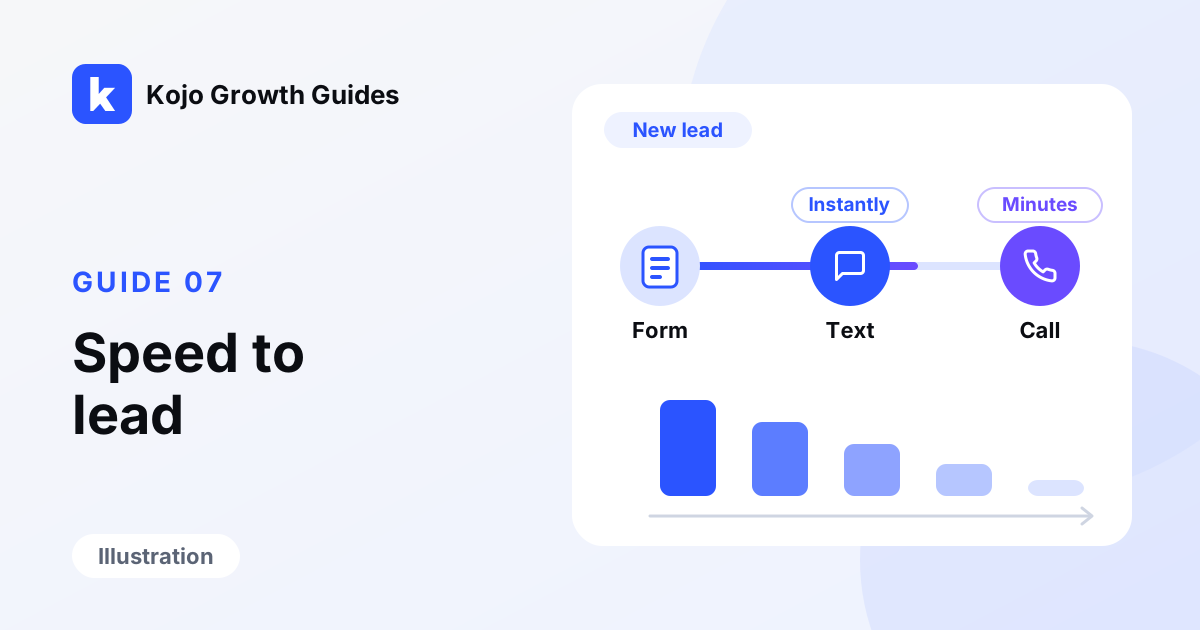
Speed to lead is how long a lead waits before your business replies. A Harvard Business Review study found that firms that tried to contact a lead within an hour were nearly seven times as likely to qualify it as firms that tried an hour later. In our view, a trade business should text at once and call within minutes.
The research behind that claim is from 2007 and 2011 and did not study trade businesses, so the advice here is labeled as our view. Kojo OS texts a new lead instantly and calls within minutes, on the calling hours each business sets, or at once if they reply yes; the legal section below sets out the rules.
What is speed to lead?
Speed to lead, also called lead response time, is the gap between the moment someone asks to hear from you and the moment your business first gets back to them. That moment might be a form on your website, a click on an ad, or a call you could not pick up.
Our working definition counts only a real reply. An automatic "we got your request" message does not count unless a person or a working system follows it up. What counts is a text written for that person, or a call from someone who can talk about the job.
What does the research say about lead response time?
The best-known source is "The Short Life of Online Sales Leads," by James Oldroyd, Kristina McElheran and David Elkington, in Harvard Business Review in March 2011. The authors studied 1.25 million sales leads received by 29 consumer-facing and 13 business-to-business companies in the US.
Firms that tried to contact a lead within an hour of the query were nearly seven times as likely to qualify it as firms that tried even an hour later. They were more than 60 times as likely as firms that waited 24 hours or longer. The authors defined qualifying as having a meaningful conversation with a key decision maker.
In the same Harvard Business Review study, the authors audited 2,241 US companies by sending each a web lead. 37% replied within an hour, 16% replied in one to 24 hours, 24% took longer than 24 hours and 23% never replied at all. Among companies that replied at all in the 30-day test, the average wait was 42 hours.
Know the limits. The article is from 2011. It does not report results for trade businesses. It describes firms that tried to make contact, and fast firms may differ from slow ones in other ways. One of the three authors was the chief executive of a sales software company.
Is the five-minute rule real?
The famous five-minute number comes from an older study. In 2007, James Oldroyd, then at MIT, looked at three years of data on more than 15,000 web leads and more than 100,000 call attempts at six companies. The odds of reaching a lead were 100 times higher when the first call came within five minutes than within 30 minutes. The odds of qualifying the lead were 21 times higher.
Treat it with care. It was presented at an industry conference and used call data from a sales software company that had asked for the study. It covers six companies, and it is almost two decades old. It also found that how fast you reply mattered more than the day of the week or the time of day. Read it as a sign that minutes matter, not as an exact law.
Why do trade businesses lose leads?
The Harvard Business Review authors name causes inside sales teams: leads pulled from the CRM once a day instead of all day, reps busy chasing their own prospects, and rules for sharing leads by geography and fairness. A trade business has different ones. In our view, three do most of the damage.
- You are on a job. Under a sink or on a roof, you cannot answer. The lead is not ignored on purpose. It just waits until you are free.
- It arrives after hours. A request sent at nine at night sits until someone looks at it the next morning.
- The callback slips a day or more. In the Harvard Business Review data, firms that waited 24 hours or longer fell furthest behind.
Our opinion, not a finding: a homeowner who needs a job done often asks more than one business, so the first useful reply gets the conversation. A missed call text back covers the calls you cannot pick up, and the rest of this guide covers forms and ad leads.
How fast should you respond to a lead?
No study measured trade businesses, so this is our view, built on the research above. Reply at once, call within minutes, and treat an hour as the outer edge.
- During business hours: text right away, then call within minutes. The text tells them you saw the request. The call is the real conversation.
- After hours: do not call at night. Text right away and ask if now is a good time. Call at once if they say yes; otherwise call first thing in the morning.
- No answer: try again later the same day and again the next day, by text, email and call, until they reply, book or say stop.
- They say stop: stop at once, on every channel.
Our opinion, not a rule: measure the gap between the request and your first real reply, and aim to get most leads under a few minutes during your hours. A true emergency, like a burst pipe at midnight, is a phone-answering problem and needs a different tool.
How does automated lead follow-up work?
AI lead follow up is the routine above, run by software so it does not depend on whether you are free. Here is the sequence Kojo OS uses for a new lead:
- The lead asks to hear from you, on a form from your ad or website, and agrees to be contacted on that form.
- They are texted instantly. The text confirms that you have their request; the call within minutes is the real reply. The text goes out right away, day or night; the call goes out on the calling hours you set, or at once if they reply yes.
- Your AI agent calls within minutes from a local number registered to your business. It qualifies the job, answers questions and books the appointment on your calendar. It hands the call to your team when someone asks for a person, and it says it is an AI if you ask.
- If they do not answer, follow-up continues by text, email and calls until they reply, book or say stop.
- Everything is logged in your CRM, or one we set up for you, tagged to the ad or page the lead came from.
In our view, the text and the call work as a pair. The text means the call is not a surprise, and a registered local number helps keep the call from being flagged as spam. See how Kojo OS works. Its job is following up and booking, not replacing a receptionist.
What hours can you legally call a new lead?
The federal rule on telephone solicitations bars calls to a residential subscriber before 8 a.m. or after 9 p.m., local time where the person is called. The Federal Trade Commission's Telemarketing Sales Rule uses the same hours unless the person has given prior consent to do otherwise. The federal definition of a telephone solicitation leaves out calls to a person who gave prior express invitation or permission.
In Kojo OS, each business sets its own calling hours, in the lead's own time zone. A lead who sends a form late is texted right away and asked if now is a good time; a yes gets a call at once, because they asked for it. Some states are stricter than the federal rule. Florida's telemarketing law, for one, bars commercial solicitation calls before 8am or after 8pm and sets a limit of three such calls to one person in 24 hours on the same subject. Kojo OS can apply a state's stricter hours like these.
One more rule matters for AI lead follow up. In 2024 the FCC ruled that calls made with AI-generated voices count as an artificial voice under the Telephone Consumer Protection Act. The caller needs the person's prior express consent first, and written consent when the call is telemarketing. That is why every Kojo OS form carries consent wording and texts stop when someone replies STOP. This describes what the rules say. It is not legal advice, so check with your own adviser about your state.
What to do this week
- Pull your last ten leads. For each, write down when the request arrived and when you first replied. Note the slowest one.
- Turn on a phone alert for every new form and every missed call, so you see them while you are on a job.
- Write one short text that says you got the request and when you will call. Keep it ready to send.
- Set your after-hours rule: the earliest time you will text or call in the morning, and who does it.
- Fill in your own form from your phone as a test, and time how long a reply takes.
- Check that every form says people agree to be contacted, and that replying STOP stops the texts.
What this does not promise
Faster follow-up does not promise more booked jobs. No study cited here measured trade businesses, the research is from 2007 and 2011, and it shows a link between speed and results, not proof that speed alone causes them. Many leads will not answer however fast you are. The rules described are general information, not legal advice, and they change, so check them again before you rely on them.
Want to hear the speed for yourself?
The quickest way to see texted instantly and called within minutes is to be the lead. Fill in a short form, get a text right away, and our AI calls you within minutes from a local number. One call will show you whether that pace is what you want for your own leads. Get my free demo.
Sources
- Harvard Business Review: The Short Life of Online Sales Leads (Oldroyd, McElheran, Elkington, March 2011)
- BYU ScholarsArchive: citation record for The Short Life of Online Sales Leads (volume 89, issue 3, page 28)
- How Much Time Do You Have Before Web-Generated Leads Go Cold? Lead Response Management study summary, 2007 (industry-sponsored)
- Cornell Legal Information Institute: 47 CFR 64.1200, delivery restrictions (calling hours and definitions)
- FTC business guidance: Complying with the Telemarketing Sales Rule (calling time restrictions)
- Florida Statutes 501.616: unlawful acts and practices by commercial telephone sellers (calling hours and call limits)
- FCC Declaratory Ruling 24-17: the TCPA applies to AI technologies that generate human voices (February 2024)
- FCC news release: FCC Makes AI-Generated Voices in Robocalls Illegal (February 8, 2024)