
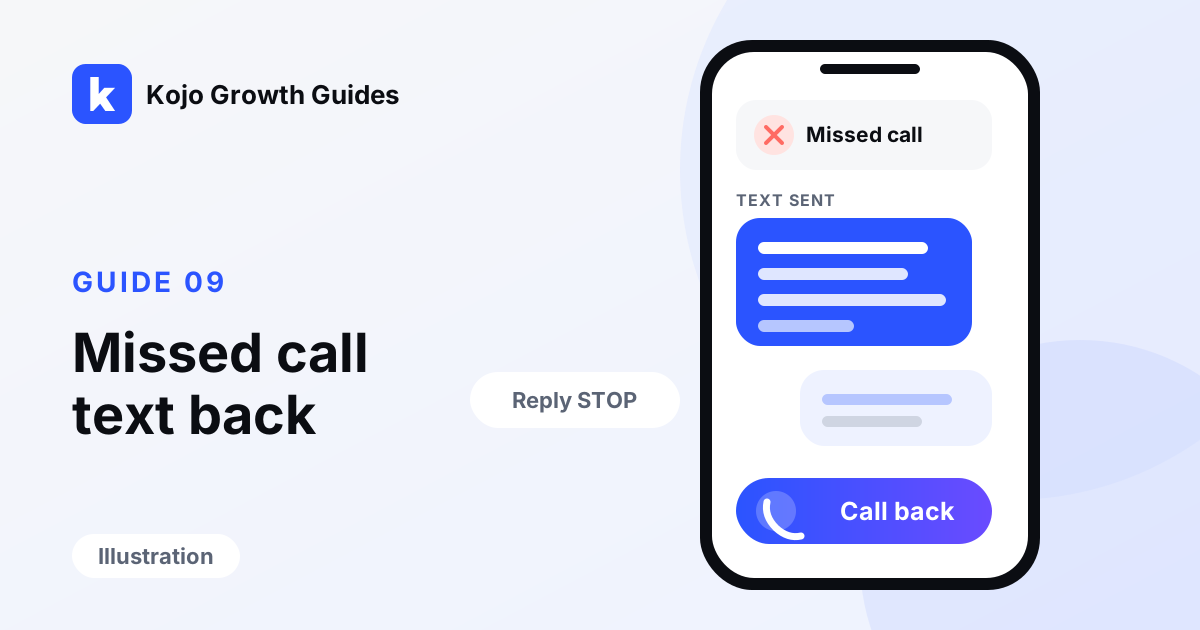
Missed call text back is an automatic text that goes to someone who called your business and did not reach a person. It says who you are, asks what they need and gives a next step, so the caller is not left with a phone that just rang out. For a trade business, it starts a conversation.
Below are three example texts you can adapt. The rules on opt-outs and carrier registration come from the sources listed at the end. This is not legal advice.
How does missed call text back work?
Someone calls your business number. Nobody answers, because you are on a roof, under a sink or already on another call. A tool notices the unanswered call and sends a text from your business number to the caller. The caller replies, and the reply lands in an inbox or on your phone.
Several types of tool can do this: a feature in a business phone system, a feature in a CRM, a stand-alone app, or a full follow-up system. They differ in what happens next. Some stop after one text. Others also call back. This guide gives no reply-rate figure, because every number we found came from a software seller and we could not check it.
What should a missed call text say?
Our opinion, not a rule: keep it to four things. Who you are, a short apology, one question, and a next step. CTIA, the wireless industry body, asks senders to make clear who the message is from, and says a message should state how to opt out. A short STOP line does that.
Here are three examples we wrote for a trade business. Each one is an example. Swap in your own business name, hours and voice.
- Example 1, any trade: "Hi, this is Your Business. Sorry we missed your call. What do you need help with? Reply here and we will call you back as soon as we can. Reply STOP to stop texts."
- Example 2, urgent trades such as plumbing or heating: "Your Business here. Sorry we missed your call. If this is an emergency, call 911. If it is a repair, reply with your address and what is going on, and we will call you back. Reply STOP to stop texts."
- Example 3, after hours: "Hi, this is Your Business. Thanks for calling. Our office is closed right now and opens at [time]. Tell us what you need and we will call you back then. Reply STOP to stop texts."
Notice what is missing: no offer, no discount, no link. The section on what a text should never do says why.
When should you follow the text with a call?
Our opinion, not a rule: the text starts the exchange and the call settles it. Call back when the caller replies asking for a call, when your text said you would, and when the job sounds urgent, such as a leak or no heat. For a plain quote request, one return call plus the text is enough. If you reach voicemail, leave your business name and number.
Keep calls inside normal hours. The FCC's rule on telephone solicitations bars them before 8 a.m. or after 9 p.m. at the called person's location. That rule is written for solicitations, not return calls, but in our view a narrower window is a safe habit. Kojo OS calls between 8am and 9pm in the caller's time zone, or right away when they reply yes.
Is a missed call text a reply or a marketing text?
CTIA sorts business texts into three kinds. Conversational: the person texted you first and you only respond; no extra permission is expected. Informational: the person gave you their number and asked to be contacted, such as a welcome text or appointment reminder; they need to agree to texts for that purpose. Promotional: sales or marketing, which should have the person's written agreement first. CTIA adds that a call to action, such as a coupon code, may move an informational text into the promotional group.
A missed call is not a text, and none of the sources we read names missed call text back. So there is no clean yes or no here. The FCC's closest guidance is a 2015 order: a one-time text sent right away is allowed if the consumer requested it and it holds only what was asked, with no marketing. That order is about people who asked for a text, so read it as a guide to the idea, not a ruling on missed calls.
The FCC order also repeats a 1992 statement that people who knowingly give out their phone number have, in effect, invited calls at it unless they say otherwise. Whether a caller who never typed their number anywhere has done that is not answered in the sources. Check with your own adviser before you build anything on it.
What happens when someone replies STOP?
The texts must stop. CTIA says people should be able to opt out at any time, by text, call or email, and that senders should send one final confirmation and nothing after it. CTIA also says plain wording such as end, unsubscribe, cancel, quit or "please opt me out" should be acted on, and that capital letters and punctuation should not matter.
The FCC's rule says that replying stop, quit, end, revoke, opt out, cancel or unsubscribe counts as revoking consent, that requests must be honored within ten business days, and that one confirmation text with no marketing is allowed. A rule published on October 26, 2026, effective November 25, 2026, lets a sender name its own exclusive way to opt out if it discloses it. For senders who name none, other plain wording counts if a reasonable person would read it that way.
In our view, set the tool so a STOP takes effect at once, and test it. Check the FCC's current rules before you rely on the details.
Do you have to register before texting from a local number?
For automatic texts from a business, yes. The Campaign Registry, the system behind carrier registration, says any business that texts customers or employees from a standard local number must register, including for individual messages that are not marketing. A business registers through a messaging provider, not directly. T-Mobile, one of the carriers, says business messages must be part of an approved campaign to reach its customers.
T-Mobile calls texts that people send from their own phones consumer messages, and all other texts non-consumer messages. It also says businesses that use unapproved routes risk messages being delayed or not delivered. So a text you tap out by hand is one thing, and an automatic text from software is another. Ask whoever sends your texts whether your number is registered to your business.
What should a missed call text never do?
- Add an offer. CTIA says a call to action such as a coupon code may make a text promotional, and promotional texts should have written agreement first.
- Keep texting someone who never replied. In our view, a missed call text is a one-time answer. For recurring messages, CTIA asks senders to confirm enrollment and say how to opt out. In our view, a caller who only phoned you has not signed up for a series.
- Ignore "please stop". CTIA and the FCC both say plain-language opt-outs count, not just the one keyword.
- Hide who you are. CTIA says links must not conceal the sender, and that a link shortener should be dedicated to the sender. Our opinion, not a rule: leave links out of the first text.
- Use it to build a marketing list. Text people who asked to hear from you. CTIA says not to send to opt-in lists that were rented, sold or shared.
Can a missed call text and call be automatic?
Kojo OS works on a simple rule: texted instantly, called within minutes. For a missed caller, it sends the text automatically and then calls within minutes, on the calling hours you set. Late at night the text asks if now is a good time, and a yes gets a call right away. How consent is handled for callers who never filled in a form is something to settle with us before go-live. The text goes from a local number registered to your business, and a STOP reply ends the texts.
If you want that handled for you, see what Kojo OS includes and our email and text follow-up page. Our guide on speed to lead covers why the first reply matters.
What to do this week
- Call your own business number from a phone nobody knows and let it ring out. Do you get a text back? Read exactly what it says.
- Write your text from one of the examples: your business name, a short apology, one question, a next step and a STOP line. Read it out loud. Remove any offer or link.
- Decide who calls back after a missed call and write it on a card by the phone. Keep calls inside normal hours.
- Ask whoever sends your texts two questions: is our number registered with the carriers, and what happens when someone replies STOP?
- Test it. Text STOP from a spare phone and check that the texts end and only one confirmation arrives.
What this does not promise
This guide does not promise that a text will turn a missed call into a job, and it gives no reply rate because we found no independent figure to check. It is not legal advice. The sources are rules and industry guidance as we read them, they change, and none of them names missed call text back. Registering with the carriers and honoring STOP lower the risk of unwanted or blocked messages, but they do not promise delivery.
Hear the text and the call for yourself
Fill in the short form and Kojo OS texts you instantly. Our AI then calls within minutes, from a local number. Send it late at night and the text asks first whether now is a good time. Take the call as a caller would and see whether the text-then-call pairing suits your business. Get my free demo.
Sources
- Federal Register: the FCC's 2026 rule on revoking consent to calls and texts (published October 26, 2026)
- CTIA: Messaging Principles and Best Practices (May 2023)
- FCC: Declaratory Ruling and Order 15-72 (2015)
- eCFR: 47 CFR 64.1200, delivery restrictions
- Federal Register: FCC final rule on revoking consent to robocalls and robotexts (March 5, 2024)
- The Campaign Registry: who needs to register for business texting from local numbers
- T-Mobile Support: consumer versus non-consumer text messaging