
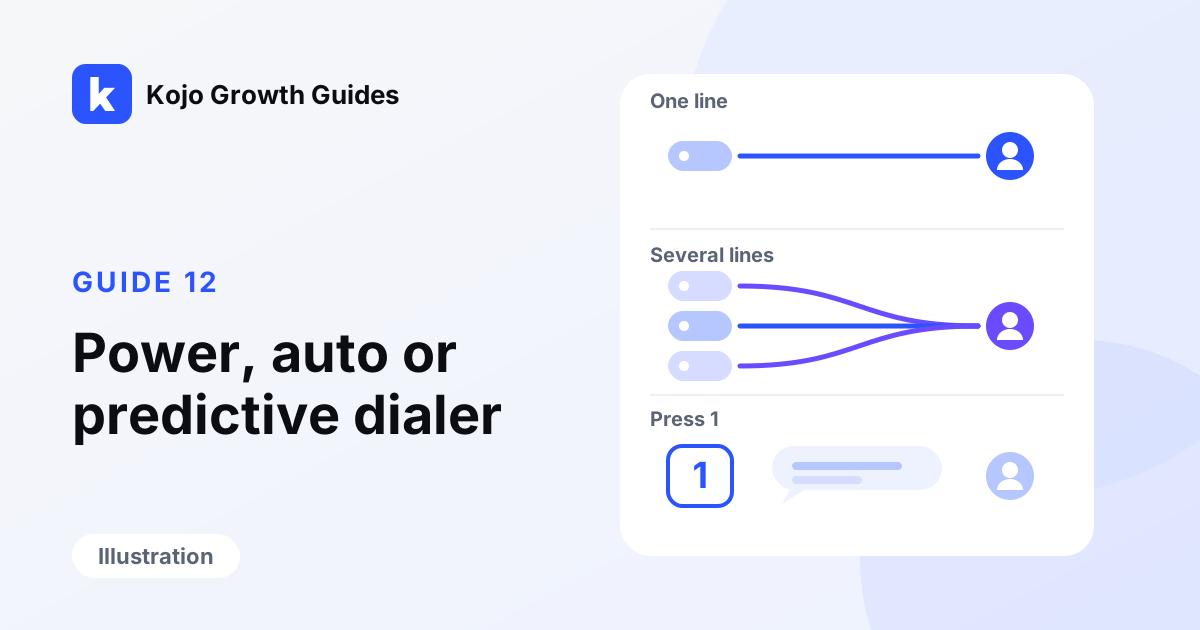
A power dialer calls one number at a time and dials the next as soon as the rep finishes. A predictive dialer dials several numbers at once and passes each answered call to a free rep. "Auto dialer" is the umbrella term. In our view, an owner with one or two reps calling their own leads wants a power dialer.
The choice is not only about speed. US rules treat these tools differently: the FTC limits how many answered calls a predictive dialer may drop, and the federal autodialer law turns on consent. This is explanation, not advice.
What is a power dialer?
A power dialer works through a list one number at a time. The rep finishes a call, logs the result, and the next number dials. Only one line is open at once, so the person who answers always reaches a rep who is already on the phone and ready for them.
The tradeoff is idle time. A power dialer does not start the next call while the rep is talking, so on a list where many calls go unanswered, the rep waits through the rings and the voicemail greetings. You give up some volume to make sure no one answers to silence.
What is a predictive dialer, and why do some calls go quiet?
A predictive dialer places several calls at once for each free rep and uses software to guess when a rep will be available. When someone answers, the call goes to the next free rep. The FCC described it in 2003 as a system that dials in a way that predicts when a person will answer and a rep will be ready.
The guess can be wrong. If more people answer than there are free reps, someone hears silence or gets hung up on. The FTC's Telemarketing Sales Rule calls a call "abandoned" if a person answers and the telemarketer does not connect them to a sales rep within two seconds of the end of their greeting.
The rule includes a safe harbor, a set of conditions. Keep abandoned calls to no more than 3 percent of calls a person answers, measured over each calling campaign (over each 30-day stretch for a longer one). Play a recorded message with your name and phone number when no rep is free. Let unanswered calls ring 15 seconds or four rings. The FCC has a matching rule.
What does "auto dialer" mean?
The term is used two ways. Some mean any software that dials for you, which covers power and predictive dialers. Others mean an older system that plays a recording and asks the person to press a key to reach someone. The FTC's consumer guidance says a sales robocall is illegal unless the company has the person's written permission to call that way.
The law uses its own term, "automatic telephone dialing system," or autodialer, defined in the Telephone Consumer Protection Act (TCPA). The word on a vendor's page and the word in the statute are not the same thing, and the Supreme Court read the statute's version narrowly in 2021.
Which one fits a small sales team?
Our opinion, not a rule: the right type follows the size of the team and the kind of list.
- One or two reps calling their own leads: a power dialer. The list is short and mostly people who asked to hear from you, so each answer matters more than volume. A predictive dialer's guessing needs several reps to work with.
- A call center with many reps and long cold lists: a predictive dialer can keep reps talking. It also brings the abandoned-call limit above, which someone has to measure and watch.
- A recording that asks people to press a key: a different tool with a different rule, because it uses a recorded voice. Look at the consent rules below before you consider one.
- Not sure yet: start with a power dialer on a list of people who asked to hear from you. Speed to the first call is a separate question, covered in our guide to speed to lead.
What did the Supreme Court decide about autodialers?
The TCPA bars non-emergency calls to cell phones made with an autodialer or an artificial or prerecorded voice, unless the person gave prior express consent. The statute defines an autodialer as equipment that can store or produce numbers to be called using a random or sequential number generator, and dial them.
In Facebook v. Duguid, decided April 1, 2021, the Supreme Court held that equipment qualifies only if it can store or produce numbers using a random or sequential number generator. Facebook's system texted numbers kept in a database, so it did not qualify. In 2003, the FCC had treated predictive dialers as autodialers. Whether a given dialer meets the Court's reading is a legal question.
The Court did not touch the second prong. The ban on an artificial or prerecorded voice stands, and in February 2024 the FCC confirmed that AI technologies that generate human voices count as one, so those calls need the person's prior express consent. For autodialed or artificial-voice telemarketing calls, FCC rules ask for written consent: a signature, which can be electronic, that is not a condition of buying anything.
What do the Do Not Call and calling-hour rules say?
These apply whatever kind of dialer is used. The Telemarketing Sales Rule bars a telemarketing call to a number on the National Do Not Call Registry, or to anyone who has told that seller to stop, unless an exception applies. The registry covers personal numbers, cell phones included. It does not cover business lines, and a registration does not expire. Sellers must sync their lists with it at least every 31 days.
Two exceptions matter to a business that follows up on leads. A person can give a specific seller written permission, with a signature, to call. And an existing business relationship allows calls for up to 18 months after a purchase, or three months after the person made an inquiry or applied, unless they ask you to stop. That exception covers the Do Not Call registry only; consent for autodialed or AI-voice calls is a separate rule. Whether a particular lead counts is a legal question. Some states are stricter.
The same rule sets calling hours: without the person's consent, calls to a home may only be made between 8 a.m. and 9 p.m. local time at the called person's location.
Which dialer does an owner-run service business need?
Kojo OS includes a power dialer with smart call lists that refresh every day, and hot leads ring your team. Your reps work through them with the power dialer. New leads are texted instantly and called within minutes by your AI agent.
AI calls go out on the calling hours you set, or right away when a lead asks for a call, from local numbers registered to your business, with spam-flag monitoring. Kojo OS is built for leads who asked to hear from you. Our guide to Spam Likely calls covers how a number ends up flagged.
What to do this week
- Write down who calls your leads today, how many calls each person makes in a day and how many go unanswered. That tells you whether you need a dialer at all, and which kind.
- Ask any dialer you are considering which type it is: power, predictive or a recording that asks for a key press. If it is predictive, ask how it keeps abandoned calls under the 3 percent limit.
- Check where each list came from: a form, a referral or a bought list. Note whether each person asked to be contacted, and keep that record.
- Compare your calling hours with the 8 a.m. to 9 p.m. window, and read the consent wording on your own forms.
- Write down which numbers on your lists are cell phones and which are business lines, since the rules treat them differently.
What this does not promise
This explains what the rules say and is general information, not legal advice. Check with your own adviser before you choose a dialer or call a list. No dialer type, and nothing here, promises more booked jobs, more answered calls or protection from complaints, fines or lawsuits. Courts and agencies change how these rules are read, and this was checked against the sources listed below in October 2026.
Hear how the calls sound
Fill in the short form and you get a text right away. Within minutes, our AI calls you from a local number. Listen to how the call sounds, then decide whether it suits your own leads. Get my free demo.
Sources
- eCFR, 16 CFR 310.4: Telemarketing Sales Rule, abusive telemarketing acts (abandoned calls, safe harbor, calling hours)
- FTC: Complying with the Telemarketing Sales Rule
- FTC: Q&A for telemarketers and sellers about the Do Not Call provisions
- FTC consumer advice: National Do Not Call Registry FAQs
- FTC consumer advice: Robocalls
- 47 U.S.C. 227 (Telephone Consumer Protection Act), Legal Information Institute
- eCFR, 47 CFR 64.1200: FCC rules on delivery restrictions (consent, abandoned calls, Do Not Call)
- Facebook, Inc. v. Duguid, No. 19-511 (U.S. Apr. 1, 2021), Legal Information Institute
- FCC 03-153: 2003 Telephone Consumer Protection Act order (predictive dialers)
- FCC 24-17: 2024 declaratory ruling on AI technologies that generate human voices